

What can I do to get rid of a bloated stomach?
We're quick to blame specific foods or intolerances for our balloon belly. But this often isn't the case. Here's one common reason why many of us experience persistent bloating, and what to do about it.
You wake up feeling fine, but as the day goes on you get more and more bloated. By the end of the day, you've loosened all the buttons on your jeans. That's not to mention the wind. Sound familiar?
If it does, you’re not the only one. Bloating affects 1 in 5 of us on a weekly basis. But do you know the reason why you're bloated?
Gluten? Dairy? Garlic? Most of us are often quick to blame specific foods or intolerances for our balloon belly. So what is the cause of my bloating, and most importantly, what can you do to get rid of a bloated stomach?
But for many of us, bloating is not related to food intolerances at all. The research suggests that the most common culprit of bloating is actually constipation.
You might be thinking “But I go to the toilet everyday, I can’t be constipated.” Here’s the thing. Even if you have a bowel movement daily, you may not be completely emptying your bowels. You might be passing 70% of your waste, but the 30% that remains builds up in your system. After a few days of buildup, you can experience a blockage and worsening constipation.
So when determining whether you might be experiencing back-up bloating, the first important question is to ask yourself whether you feel completely emptied after going to the toilet.
The second part is to assess the consistency of your bowel movements. If your stools are small hard pellets that are difficult to pass, this is a good indication you are constipated. But did you know that some of the more severe forms of constipation are in people who actually have diarrhoea?
This occurs when there’s solid excrement backed up in the colon, but the liquid is able to sneak through the cracks and come through as diarrhoea. So if you’re going to the toilet often, it doesn’t mean you’re necessarily emptying our all the waste; the diarrhoea could be signs of a much larger back-up occurring.
So how can you beat the bloat? To do this, you need to resolve the underlying issue: the constipation. Here’s what you can do to get rid of a bloated stomach:
💦 Step 1: Increase hydration.
Increase your water intake to get the digestive system moving again. If your 💩's are coming out as hard pellets, or you're needing to strain, you are not getting enough.
🏃🏽♀️ Step 2: Move your body daily.
This helps the contractions of the gut move the contents through your body. Aim for 30-60 min of light to moderate exercise daily.
⏰ Step 3: Leave 3-4 hours between each meal.
This allows the smooth muscles of the intestine to propel the contents of your gut through the body more efficiently. This only happens when you haven't eaten for 90 min or more.
🥬 Step 4: Increase fibre intake slowly.
The most important one. Fibre is the most powerful dietary tool to improve bowel regularity and consistency. Importantly, fibre promotes a complete and easy bowel evacuation. If you're just starting out, aim to increase fibre by 1-3g every 2 days. This can be from fruit, veg, grains, or seeds. But if you've had constipation for a while, and have a lower transit time, you need to consider a fibre supplement.
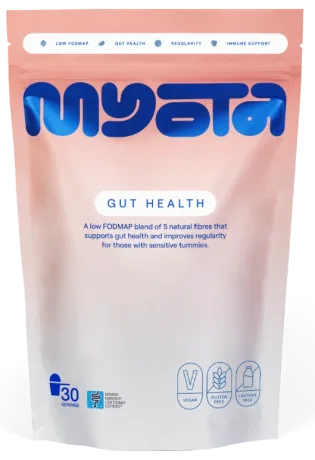
myota's Gut Booster blend
To relieve constipation, bloating and wind, we recommend myota's Gut Booster blend. This gentle blend of fibres softens stools and promotes more regular bowel movements, without causing additional bloating and gas that can sometimes come from fermentable fibres. Our mix is low FODMAP certified so is suitable for people following a low FODMAP diet.
Start with your gut
One scoop a day of clinically-proven prebiotic fibre.
Keep reading

The power of trillions: The gut microbiome for digestion and absorption
Read more
The gut microbiome: a root cause of female acne?
While acne was once considered a 'teenage' problem, we're now seeing women in their 30s, 40s, and 50s experiencing chronic and recurring skin problems. Read more to find out why this is occurring, and the potential role of your gut microbiome.
Read more
The ultimate guide to relieving constipation in children
Is your child struggling with constipation? Dive into our latest blog to learn about its causes, prevention, and a potential secret weapon to relieve constipation in children.
Read more